An exhibition by Globe Art Point and Hanken School of Economics (22 September – 21 October 2026)
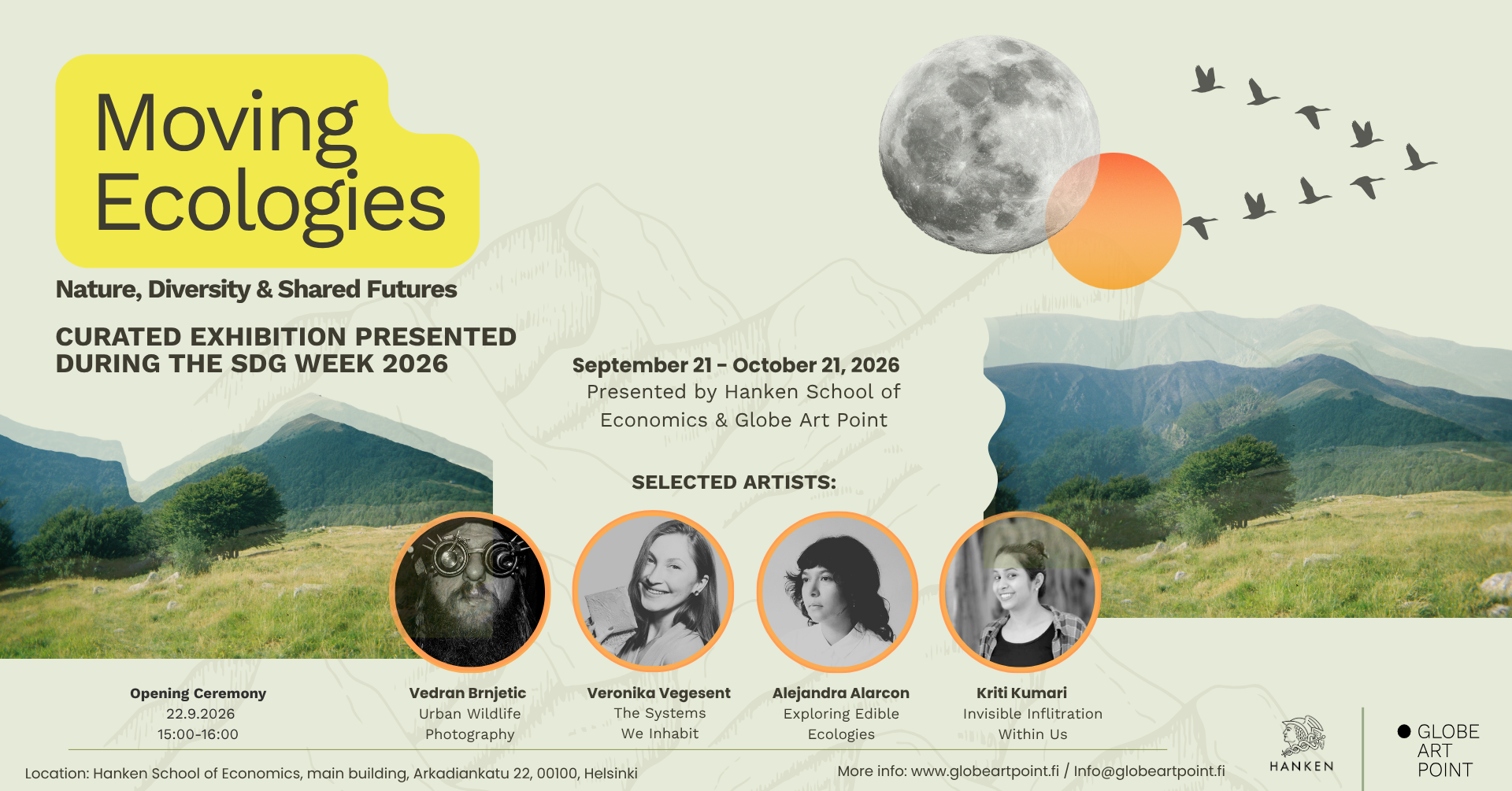
As part of the SDG Week 2026, Globe Art Point, in close collaboration with Hanken School of Economics, presents Moving Ecologies, a group exhibition that offers an authentic perspective on the interdependence of ecological and social systems.
Through artworks spanning a wide range of mediums, the participating artists provide a compelling public commentary on the ways ecosystems and cultures evolve through interaction, exchange, and adaptation. How much longer will we ignore the climate disasters, deforestation, and biodiversity loss caused by human activity? Why have we normalised indifference to such destruction? And how can we envision a livable future when the very first environment a child encounters is already shaped by pollution?
Moving Ecologies questions the interconnectedness of members of ecological communities and social systems, emphasising the often detrimental impacts of human activity on the biotic ecosystems and the ecological transformations that result from it. Through a dialogue around ecological responsibility, the exhibition urges the visitors to question human-centred perspectives and encourages them to consider their own relationship to the environments they inhabit.
Participating artists: Alejanda Alarcón, Vedran Brnjetić, Kriti Kumari and Veronika Vegesent.
Exhibiting Artists
Alejandra Alarcón (b. 1996) is an interdisciplinary Mexican artist based in Helsinki, working at the
intersection of food and art. Her interest in (food) sustainability, the socio-political, cultural, and
ecological dimensions, is strengthened by a decolonial and ecofeminist approach to knowledge
production.
Her practice moves between artistic research, performance, installation, and photography.
She uses walking, writing, drawing, baking, foraging, and cooking as artistic tools to investigate themes
of commensality, belonging, and the seasonality of things.
In her work, she also explores relationships
between different cultures and social structures through ingredients, culinary rituals, and flavor as she
has encountered them across Mexico and Finland.
Vedran Brnjetić is a photographer from Espoo, originally from rural Croatia. His work explores the relationship between animals and human-made environments, shaped in part by his childhood memories of both pristine nature and the lasting traces of human activity and war.
In Finland, he has photographed birds and mammals navigating construction sites, roads, tourist beaches, buildings and other spaces shaped by people. His photographs capture encounters that can be unsettling, humorous, beautiful or strange.
Through these observations, Vedran explores how human infrastructure and development have become part of the environments inhabited by other species. Rather than judging or separating humans from nature, his work reflects on how deeply interconnected they already are. His photographs offer observations rather than definitive answers, leaving space for viewers to interpret each encounter in their own way.
Kriti Kumari is an Indian-born artist currently pursuing an MFA at the University of the Arts Helsinki.
Guided by the principle “by nature, from nature, for nature,” her artistic practice is slow,
meditative, and rooted in ecological consciousness.
Through her work, she expresses personal emotions while drawing attention to the climate crisis
and the irreversible consequences of human actions in the Anthropocene.
Holding a degree in textile design from India, Kriti’s perspective shifted in 2015 while working in the
textile industry, where she witnessed the environmental and social impacts of fast fashion, including
toxic wastewater polluting rivers and the increasing use of synthetic materials. These experiences
inspired her transition toward sustainable, community-oriented art practices.
For over a decade, she has worked with natural, found, recycled, and upcycled materials, combining traditional handicraft techniques with a contemporary artistic language to explore humanity’s relationship with nature.
Her last exhibition was in 2025 at Tiadehalli, Helsinki.
Veronika Vegesent is an artist whose research-based practice explores society’s relationship with non-human life and the ways ecological and animal realities become invisible or normalized.
Having grown up on an animal farm where slaughter was part of everyday life, Veronika’s artistic practice is rooted in her early experiences of witnessing indifference toward animal life. She combines scientific research and critical analysis with art, bringing hidden realities into visibility.
Working with natural materials and found objects, she explores their histories, metaphoric potential and ecological meanings. Her installations often incorporate sand and stone layered onto previously used objects, reflecting on equality and the interconnectedness of all living forms within the Earth’s biosphere.
Through her work, Veronika seeks to give form to what society has collectively chosen not to see, creating spaces that challenge accepted forms of blindness and invite reflection on the boundaries between human and non-human life.
Exhibition Venue & Opening Hours
Location: Hanken School of Economics, main building, Arkadiankatu 22, 00100, Helsinki
Opening hours:
Mondays – Thursdays: 8.00 – 20.00
Fridays: 8.00 – 16.00
(After 4 PM, you should ring the doorbell)
_________________________________________________________________________________
Globe Art Point (GAP) is a non-profit organisation dedicated to promoting diversity, equity and inclusion within the arts and cultural sector. Committed to creating professional opportunities and enhancing the visibility of its members, GAP welcomed the opportunity to collaborate with Hanken on an open call centred on the theme of “Moving Ecologies”. The selected artworks were chosen based on their artistic quality, relevance to the theme and their contribution to a collective exploration of sustainability that acknowledges the interconnected nature of biological and social diversity.
More info: [email protected]